What are stablecoins? How to use stablecoins for low-risk investments?
- Ethan 劉呈顥

- May 3, 2025
- 5 min read
In the cryptocurrency circle, there is a saying:
"One day in the cryptocurrency world is like ten years in the real world"
The large fluctuations in the cryptocurrency market often make investors confused about when to buy and when to sell. We often hear that some people make several times or even dozens of times the profit in a single day in the cryptocurrency market; but at the same time, there are also many people who lose 100% of their capital in a single day.
However, in such a volatile cryptocurrency market, if you choose stablecoins for investment, you can avoid the risk of large fluctuations. The stablecoins provided by some exchanges have an annualized return of 5-10%, which is an amazing profit in terms of stable returns.
Next, let us use this article to introduce what stablecoins are and how to use stablecoins to make low-risk investments in the cryptocurrency market.
(This article is for reference only, and you should conduct a self-risk assessment before investing)
What are stablecoins?
Stablecoin is a type of cryptocurrency that maintains the stability of its value by being supported by stable assets.
Taking the US dollar stablecoin as an example, for every 1 US dollar stablecoin, 1 US dollar of fiat currency (legal currency) must be stored behind it to guarantee it, so that the price of each US dollar stablecoin can always be maintained at 1 US dollar.
Simply put, you can buy 1 USD stablecoin with 1 USD.
Currently, stablecoins are divided into fiat stablecoins, cryptocurrency stablecoins and algorithmic stablecoins according to different collateral methods.
Fiat Stablecoins
Legal stablecoins refer to cryptocurrencies issued by "centralized institutions". Institutions that issue stablecoins must guarantee 1:1 fiat currency storage.
In other words, if you want to issue 1 million USD stablecoins today, you must deposit 1 million USD in a bank account. This ensures that anyone who holds USD stablecoins today can exchange their cryptocurrency back into fiat currency at any time.
Here are some common legal stablecoins
USDT (Tether USD)
USDT, also known as "Tether", is issued by Tether. It is the oldest and most widely used US dollar stablecoin, and its trading volume ranks first among current legal stablecoins.
Tether's parent company Bitfinex publishes audit reports from time to time, but these audits do not meet the standards of traditional audits. Therefore, many people suspect that USDT is simply issued out of thin air and there is no US dollar collateral behind it.
USDC(USD Coin)
USD Coin, referred to as USDC, is issued by Center Alliance, a joint venture established by the exchange Coinbase and Circle under Goldman Sachs. USDC is audited and disclosed by an accounting service company every month to let users know that there is a sufficient amount of US dollars as collateral. Compared with USDT, USDC is a stablecoin with higher transparency.
In addition, the US dollar stablecoin is often referred to as "U".
Cryptocurrency Stablecoins
Compared with the US dollar stablecoin that uses the US dollar as a reserve asset, the cryptocurrency stablecoin, as the name suggests, is a stablecoin that uses cryptocurrency as a reserve asset to maintain a 1:1 exchange rate with the US dollar.
The following is an illustration of cryptocurrency stablecoins using the DAI stablecoin created by MakerDAO.
DAI Stablecoin
Created by MakerDAO, a decentralized autonomous organization. It operates in a decentralized approach by using smart contracts.
However, because the value of the pledged crypto assets themselves fluctuates greatly, over-collateralization will be carried out, that is, the value of the pledged assets will exceed the value of the issued stablecoins to withstand the price fluctuations of the crypto assets.
For example, if the DAI stablecoin uses "Ether" as the reserve currency for collateral, it must reserve 1.5 to 2 times the value of Ether as the stablecoin, which means that the pledge rate must be maintained between 150% and 200%.
If the price of "Ether" falls sharply and the pledge ratio falls below 150%, liquidation will occur to maintain the value of the stablecoin DAI.
Algorithmic Stablecoins
Algorithmic stablecoins are created through smart contract algorithms to establish a "decentralized central bank", pegged to fiat currencies, and destroyed or issued when prices are too high or too low.
The most well-known algorithmic stablecoin at present is UST issued by Terra.
UST (TerraUSD)
It is an algorithmic stablecoin running on the Terra chain. Different from the stablecoin mentioned above that uses stable assets as collateral to maintain its value, UST uses a minting-and-destruction mechanism, using Luna and UST dual currencies as leverage. When 1 UST is minted, LUNA worth $1 is burned, and the 1:1 peg between UST and the US dollar is maintained through an arbitrage mechanism.
Due to the collapse of Luna in May 2022, which triggered a massive sell-off by whales, Terra's founder Do Kwon announced that UST would be rebuilt into a collateralized stablecoin to prevent the death spiral of algorithmic stablecoins from happening again.
(Updated: 2022.07.06)
The risks of stablecoins
From the above content, we can simply understand that each stablecoin has its own risks. We simply organize these risks into the following contents:
How to invest in stablecoins?
If we look at the banks on the market, the annualized return rate of major banks is currently about 1%. Even the recently popular digital banks have an annualized return rate of only 2.2% for current deposits. However, stablecoin current deposits can have a return of 10%.
From this perspective, as long as you do not convert stablecoins into other currencies with large fluctuations, you can have an annualized rate of return that is better than that of banks on the market.
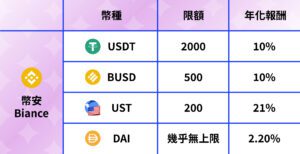
Now let’s take a quick look at the annualized returns offered by various common USD stablecoins on major exchanges.
Binance
The world's largest exchange, with the most security and a wide range of currencies.
FTX Exchange
Mainly lending, the annualized return may be less than 1% in a bear market, but can be as high as 18% in a bull market. A complete tutorial on lending will be released later.
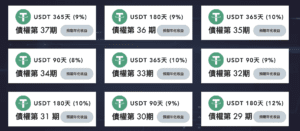
Taiwan's first exchange - ACE
We regularly launch bond subscriptions to lock in a dedicated model for both borrowers and lenders, control risk structure, and allow users to increase the value of their assets by subscribing to higher-quality bonds. Depending on the level of the activity, there will be an annualized return of 8-20%.
The latest event is a 90-day 10% annualized reward during the Mother’s Day period (until 5/13), with a minimum of 1,000 USDT.

Conclusion
The above is a compilation of some exchanges and information for everyone. In a bear market, stablecoins can be a place to park funds and increase some passive income. Make a timely assessment before investing and choose the financial product that suits you!
References
If you want to know more about NFT, you can join the nspace community:

Comments